
Recently, CCID Consulting officially released the 2025 China AI Infra Platform Market Research Report, which comprehensively sorts out the latest pattern, technical trends and competitive landscape of China's AI infrastructure platform market. With its outstanding performance in Data&AI converged architecture, Lakehouse unified engine and enterprise-level AI implementation capabilities, KeenData has been successfully included in the report and ranked in the "Challenger" quadrant, demonstrating its leading position in the Data&AI field.
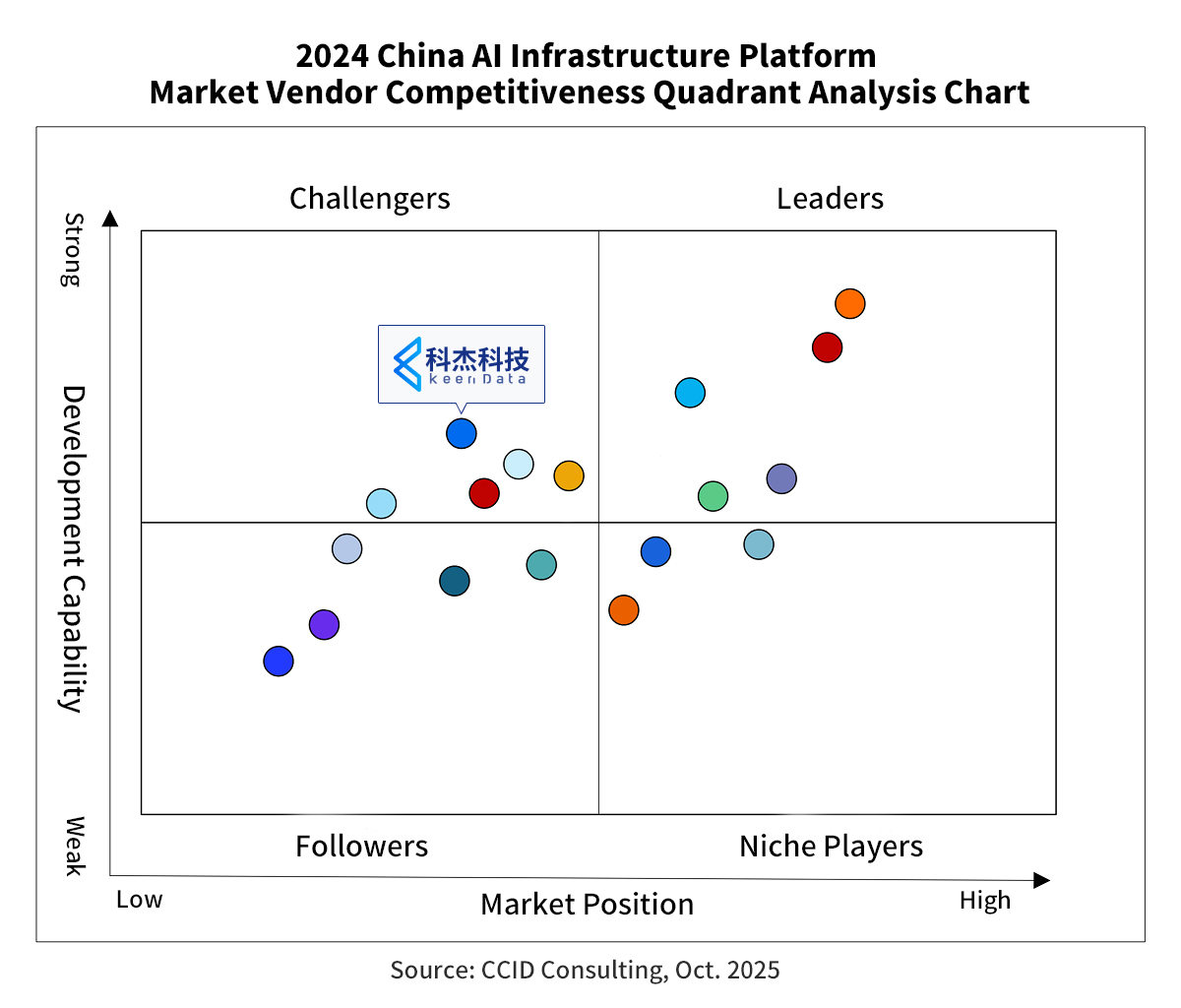
As an authoritative domestic industrial research institution, CCID Consulting has extremely strict evaluation criteria for AI infrastructure platform enterprises, covering multiple dimensions such as technological forward-looking, product maturity, industry implementation capability and ecological influence. It takes "market position" (horizontal axis, representing current market share and customer coverage breadth) and "development capability" (vertical axis, representing technological iteration speed, product implementation effect and large-scale service capability) as the core dimensions, and divides industry vendors into four quadrants.
KeenData's inclusion in the "Challenger" quadrant this time—"Challenger" does not only refer to market size or growth rate, but also represents the comprehensive leadership of enterprises in architectural originality, depth of engineering implementation and breadth of industry empowerment. Relying on its self-developed "AI-in-Lakehouse" architecture, KeenData has deeply integrated data infrastructure with AI native capabilities. The built Data&AI integrated platform has taken the lead in realizing a full-link closed loop from data governance to model training, inference and even Agent development, solving the three major problems of "poor data quality, difficulty in integration and high cost" in the large-scale implementation of enterprise AI, and building a new generation of intelligent data infrastructure for the AI-Native era.
Focus on the AI-Native Era to Build a Unified Data&AI Infrastructure
The 2025 China AI Infra Platform Market Research Report shows that the market size of China's AI Infra platform reached 3.45 billion yuan in 2024, and is expected to soar to 6.73 billion yuan in 2025, with a year-on-year growth of 95.1%. At present, enterprise AI applications have moved from the "single-point model verification" stage to the in-depth stage of "embedding into core business processes", putting forward higher requirements for infrastructure: it not only needs to support efficient inference and model management, but also must realize native integration with business data.
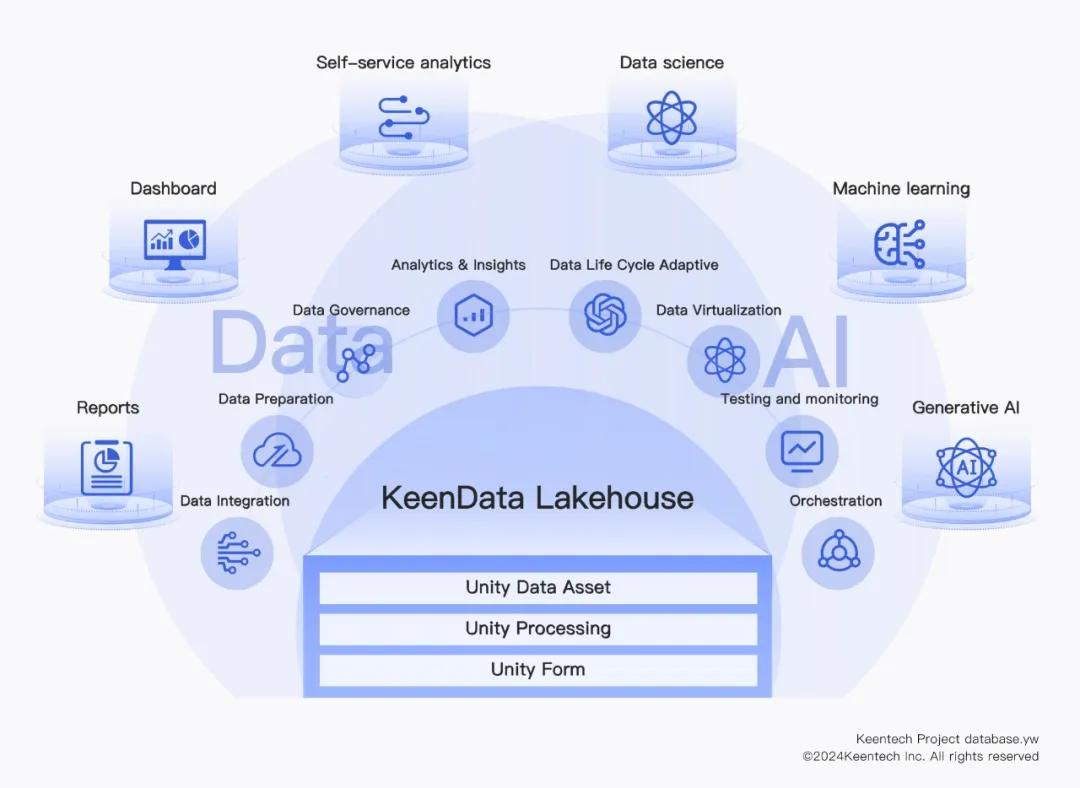
Against this background, the KeenData Lakehouse platform built by KeenData, with "AI-in-Lakehouse" as its core concept, has for the first time deeply integrated Lakehouse unification, OLAP data governance and full-lifecycle AI capabilities, constructing a truly unified data and intelligent infrastructure for the AI-Native era.
KeenData Lakehouse adopts an AI-Native intelligently driven architecture to realize integrated Data&AI engineering capabilities. Oriented towards large-scale organizations for systematic data and AI implementation, the platform provides infrastructure products covering the full-link closed loop of data integration, offline and real-time development, multi-modal computing, data governance, dataset management, AI model construction, integrated training and inference, and Agent development. Its self-developed multi-modal computing engine completes data cleaning to result analysis in a single pipeline, multiplying GPU inference throughput. Combined with KMI inference acceleration, model quantization and unified catalog (Unity Catalog-like capabilities), it realizes cross-modal intelligent governance.
Deeply Cultivate Industry Know-How to Promote Large-Scale AI Implementation in Key Fields
"Today, as computing power and algorithms gradually converge, high-quality datasets have become the key moat for the artificial intelligence industry to win," said Yu Yang, Chairman of KeenData, in his speech at the 2025 China International Digital Economy Expo, which strongly resonates with the core views of this report. Yu Yang pointed out that current enterprise AI applications generally face three major pain points: "poor data quality, difficulty in integration and high cost"—massive multi-modal data lacks unified standards, low data cleaning efficiency slows down model training progress, and waste of hardware resources leads to soaring implementation costs. These problems directly restrict the large-scale application of AI technology.
In response to this industry dilemma, Yu Yang proposed that "infrastructure in the AI era must achieve two-way empowerment—both supporting AI model evolution with high-quality data (Data for AI) and improving data governance efficiency with AI technology (AI for Data)". This concept runs through the entire product design process of KeenData: the KeenData Lakehouse platform has a built-in intelligent data governance module, practices the concept of "integrated development and governance", and constructs an AI-driven intelligent governance system. Through intelligent metadata scanning, it realizes dynamic encryption and desensitization of sensitive data, promoting the intelligent upgrade of data governance from passive control to active prevention; at the same time, it is downward compatible with heterogeneous computing power such as GPU and CPU, and improves resource utilization through intelligent scheduling algorithms, reducing storage costs by 70%.
Yu Yang emphasized that data infrastructure construction is by no means a simple technical deployment, but requires the construction of a complete system of "methodology + technology + products + practice", which is the core competitiveness that enterprises must continuously iterate. In essence, it is a comprehensive system formed by the in-depth integration of "advanced technology + mature software + AI engineering". It not only solves technical implementation problems, but also shapes a new enterprise management method through the core model of "centralized management and decentralized empowerment", making it the best practice carrier for software to deeply integrate into enterprise management. It connects technical engineering, data management, AI operations and business collaboration, helps enterprises establish a new collaborative mechanism based on data and AI needs, and ultimately promotes the all-round digital and intelligent transformation of organizations from management models, business processes to value creation, turning transformation from a slogan into sustainable growth results.
Supported by methodology, technology, products and practice, KeenData has successfully served nearly 200 large-scale organizations in more than 20 industries including manufacturing, industry, energy, finance and retail, tailoring data infrastructure and data bases that adapt to their business needs, with remarkable implementation effects. At the same time, KeenData actively responds to national policies related to Digital China and data elements, deeply participates in the planning and construction of government-side data infrastructure and trusted data spaces, undertakes projects of trusted data spaces and pilot demonstration zones in many key cities in China, fully implements its core capabilities in both government and enterprise scenarios, and continuously expands the path of data value release.
In addition, KeenData has taken the initiative to enter the overseas market, exporting advanced domestic technologies, products and methodologies to overseas countries and regions, helping them build core capabilities for development in the AI era and promoting the development of local artificial intelligence industries and digital economies. It has established in-depth cooperative relations with customers in many countries around the world, such as Saudi Arabia, Singapore, South Africa, Japan, Malaysia and the Philippines, and works with global partners to build new industrial advantages and contribute Chinese wisdom and strength to the development of the global digital economy.